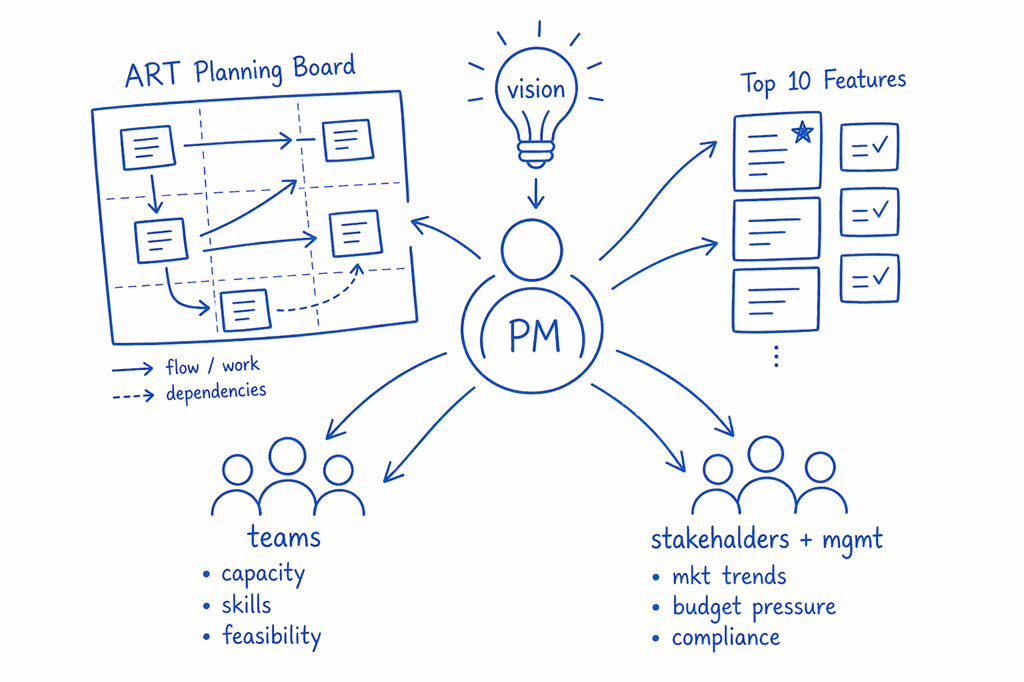
The Product Manager’s Role in PI Planning
This is a guide to understand the Product Manager’s role in PI Planning. As such, the article will describe what a Product Manager must do during PI planning. Read our earlier article about PI planning preparation to understand how to get ready for the event PI Planning is often described as the heartbeat of the Agile Release Train. This event is more than a mere planning event. This is the event where the strategy gets validated against the practicalities of delivering realities.
Product Managers Role in PI planning : The Value Gurdian
Product Managers act as a keeper of Value for the Agile Release Train- (ART). During the PI planning, a PM helps stakeholders and the teams to align, and decide what matters most, and how we will deliver it. This article will not go in depth about the PI Planning structure. This article in scaled agile website describes PI planning structure well. Here, I will talk about how a PM shows up—before and during the event—to make it actually work. Before PI Planning: What a PM must align before Day 1 Most of your impact as a PM happens before PI Planning starts. If you walk into Day 1 hoping alignment will happen in the room, you’re already late. Here I will share a few things you need to get in place early. First, stakeholder alignment. Business, Architecture, and Engineering should not be debating fundamental priorities during PI Planning. You don’t need perfect agreement—but you need enough clarity to move forward towards the intended objective Second, priority clarity. Your “Top 10” features shouldn’t be a vague wishlist. They should reflect real decisions—what makes it in, what doesn’t, and why. When you decide priorities, it is tempting to focus all your energies on the low-hanging fruit. Do not fall for the trap. Make sure to balance new features with Architecture runway. Third, dependencies. If there are known cross-team dependencies, start conversations early. Don’t wait for teams to discover them during breakouts. And finally, trade-offs. Go in with a point of view. If capacity doesn’t allow everything—and it won’t—what gives? Preparation is less about documents and more about decisions.
The Product Managers Core Role During PI Planning
Once PI Planning starts, your role becomes very visible. At a high level, you need to
- Set the direction through the vision
- Balance priorities against capacity
- Negotiate scope when capacity, skill or dependency issues arise
- Work with stakeholders to get the Business Value (BV) numbers established
- Participating in risk management (ROAM)
What you’re NOT responsible for is micromanaging team plans. A common mistake is trying to be everywhere and solve everything. That usually creates more noise than clarity. Your role is to anchor the conversation around value—and step in only when alignment is at risk.
Presenting the Vision: What You Must Bring to the Table
The vision presentation at the start of PI planning sets the tone for everything that follows. And it’s easy to get this wrong. Reading through slides won’t cut it. Teams need to understand:
- What are we trying to achieve this PI?
- Why does it matter?
- What are the few things we really care about?
The “Top 10 Features” matter—but not as a list. As a clear signal of priority. If everything sounds equally important, teams will struggle to make decisions later. Also, give guardrails:
- What does success look like?
- Are there constraints teams should be aware of?
A good vision presentation helps the team with clarity about what they should focus on.
Supporting Teams During Breakouts
Breakouts are where the real planning happens. I have seen that, during the breakouts, many PMs either overstep or disappear completely. Both do not help. The balance is important. You’re there to:
- Explain focus and priority when teams are not clear
- Help negotiate scope as an when needed – This can be because
- Facilitate alignment across Product Owners
You’re not there to dictate how teams should plan their work.
Participate in Draft Plan Reviews
Draft plan reviews are where the ART leadership (PM /RTE and system architect) first sit down with the teams to discuss the plan. This is not just a status update—it’s your chance to catch issues early. Look at:
- Team-level PI Objectives: Are the team-level PI objectives outcome-focused, or have the team just listed down the sequence of stories?
- Commitment levels: What’s committed vs uncommitted—and why? Have the teams created their commitment only on capacity basis or have they considered uncertainties like skill issues/technical feasibility and dependencies
- Capacity alignment: Are teams overloading themselves? Have they considered day to day overheads
Also, pay attention to dependencies. The ART planning board is your friend here. It helps you see where things might break before they actually do. It is often helpful to start the rough ART planning board in this segment. Don’t just listen to what teams present—look for what’s missing.
Management Review & Problem Solving: Where PMs Shine
This is usually the most intense part of PI Planning. Plans don’t fit. They don’t look like what we had hoped for. Capacity is exceeded. Dependencies create friction. This is where a skilled and prepared PM makes a difference A good Product manager should come prepared with:
- Trade-off options, not just problems – Talk about what changes and trade offs can help us go closer to our earlier ambitions – be ready with a view on what can move out if something else must come in
- Ideas on how uncommitted work could become committed – what help you need?
- Stay firm on what can not really be done – do not set unrealistic expectations. It is critical to balance Business Urgency with team capacity and technical feasibility
- Champion the Architecture runway – do not lose focus on maintaining a balance with immediate feature value and being ready for what comes next
Assigning Business Value (BV): More Than a Number
Assigning Business Value often becomes a mechanical exercise. It shouldn’t be. This is where you help stakeholders understand what really matters. Once stakeholders really “see” what your teams will be doing – alignment is easy to follow A few things to keep in mind:
- Not everything can be “high value” – encourage stakeholders to show what matters most to them
- Explain Architectural runway – help the stakeholders truly sppericiate the impact they will have if teams ignore the runway completely in favor of only immediate value
- Explain Uncommitted objectives are not low priority and team will not be ignoring those—The uncommitted status reflects uncertainty
Use this moment to create shared understanding, not just assign numbers.
Common Pitfalls in PI planning
Some patterns show up very often. Good PMs take care to avoid these. Overcommitment is the big one. Planning at 100% capacity seems efficient—but it rarely works in reality. Plan adequate but transparent buffers to allow for unexpected Another anti-pattern of is to actually plan feature delivery work in the IP iteration – This will quickly kill both innovation and your planning for the next PI Then there’s the silent PM. Being unavailable or disengaged during PI Planning creates confusion quickly. Another one is ignoring architectural runway. It’s easy to deprioritize it in favor of visible features—but the cost shows up later. And finally, over-controlling. Trying to drive every decision slows teams down and reduces ownership. The goal is not control—it’s clarity.
How to be an effective PM during PI planning
Being effective during PI Planning isn’t just about what you know—it’s about how you interact during PI planning First, presence. You don’t need to be everywhere—but you do need to be accessible. Especially in high-risk discussions. Second, knowing when to step in. — Step in when teams are not clear about priorities. If they’re debating execution details—step back Third, reading the room. — Confusion, hesitation, repeated questions—these are signals that something isn’t clear. Fourth bring clarity to management and stakeholders – help them understand trade-offs —Discuss what can and can not be done — explain the need for innovation and architecture runway Finally comes decision-making. — you will be asked to make a lot of decisions. You won’t have complete information. That’s normal. Some factors to consider are Value , risk , capacity and technical feasibility. Also consider face trade-offs: Short-term delivery vs long-term architecture or Business pressure vs technical reality Sometimes you push. Sometimes you adapt.
Conclusion: Bring enough clarity start execution
At the end of PI Planning, you’ll have a plan. But more importantly, you’ll have a level of alignment. The confidence vote is not about perfection. It’s about whether teams believe in what they’ve planned. Your role doesn’t end here. The plan needs to translate into a living backlog. Priorities need to hold—or be consciously adjusted. PI Planning is not about getting everything right upfront. It’s about creating enough clarity and alignment so that when things change—and they will—teams know how to respond. That’s what good product leadership looks like.