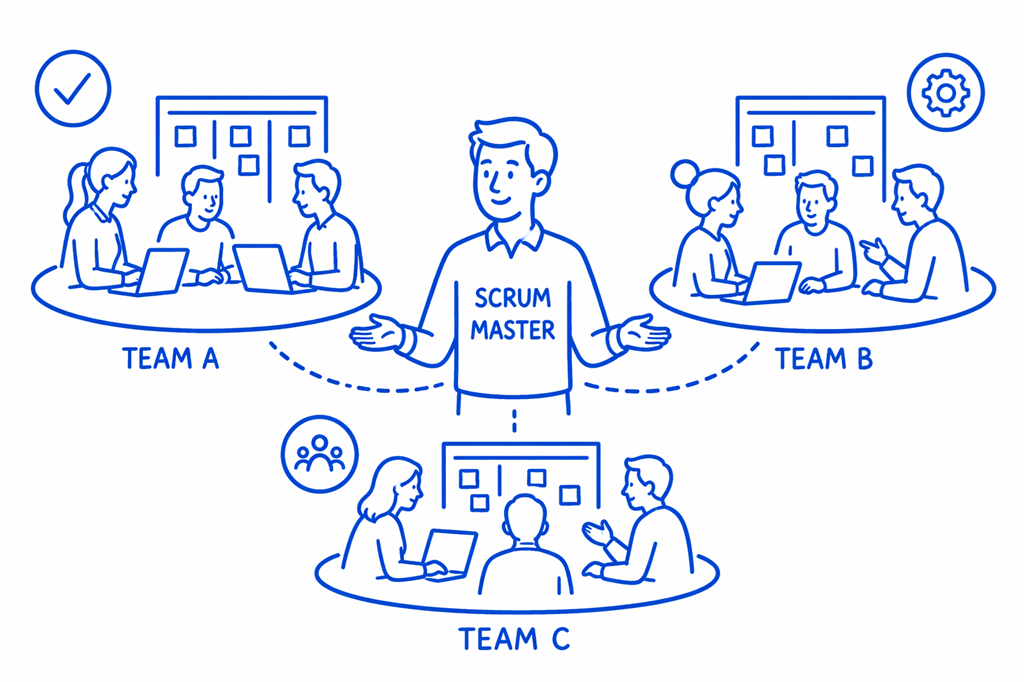
Being a Scrum Master for Multiple Teams: Why It Happens, What It Breaks, and How to Make It Work
Being a Scrum Master for Multiple Teams – Is it possible? Can it work? and rather “How to make it work?” – In almost every organization I’ve worked with, this question eventually comes up:
“Can one Scrum Master handle multiple teams?” And more often than not—the answer is already assumed to be yes.
Not because it’s ideal. But because it feels practical… It seems more efficient
Let’s be clear about why this model exists before we jump into whether it works.
Why Organizations Assign One Scrum Master to Multiple Teams
In my experience across large agile transformations, this decision usually comes from one (or more) of these reasons:
1. Budget Constraints
Agile transformations are often expected to be “lean.”
So instead of hiring one Scrum Master per team, Organizations go for one Scrum Master for 2–3 teams. On paper, it looks efficient.
2. Misunderstanding the Scrum Master Role
This is still very common. Often leadership sees the Scrum Master as:
- A meeting facilitator
- A Jira admin
- A status tracker
Then naturally, they ask – “Why can’t one person handle multiple teams?”
3. “Senior = Can Handle More”
I’ve seen this especially with Senior Scrum Masters or Experienced Developers stepping into SM roles. The logic then becomes: “They’re experienced, so they should handle more teams.”
Experience does increase effectiveness. But it doesn’t multiply time or presence.
4. Mature Teams (At Least Perception of It)
Sometimes the assumption is: “These teams are “doing” Agile for long time now. They don’t need much support.” Sometimes this is true. But many times it’s just… optimistic.
When Organizations Assign One Scrum Master to Multiple Teams
– What Actually Happens?
Let me share something I’ve seen repeatedly. I once worked with an organization where one Scrum Master supported three teams.
- Team A was high-performing
- Team B was struggling with dependencies
- Team C was newly formed
Guess where most of the Scrum Master’s time went?
👉 Team C (firefighting)
👉 Then Team B (escalations)
And Team A? -They slowly drifted. Retrospectives became routine … Improvement slowed down ….Small issues went unnoticed
Nothing broke immediately. But growth stalled.
That’s the subtle risk in this model.
Challenges You Should Expect
Despite of all this, it is inevitable that you will have to look after more than one team at a time – Below I will give some challenges you should expect in the situation
1. Context Switching Is Real
Every team has:
- Different stakeholders and Energy
- Different maturity
- Different challenges (geographical distribution / domain complexities / cultural differences /product lifecycle stage.. etc)
Switching between them isn’t just logistical—it is a definite mental stress. And this stress builds up. Slowly but surely.
2. You May Move from Deep Impact to Surface Coverage
When you work with many teams, you run the risk of spreading yourself too thin. Then, instead of:
- Coaching behaviors
- Enabling ownership
- Driving systemic improvements
You may end up:
- Just Attending Events – and this is when the Scrum Events start to turn into mere “ceremonies”
- Focusing on the obvious, on the surface “blockers” – you now lack bandwidth to go deeper to seek and address the true impediments. Read this article to understand how (and more importantly – “why” to differentiate between blocker and impediment.
3. Your Availability Becomes a Bottleneck
Teams don’t need you all the time. But when they do need you—it’s usually urgent. With multiple teams, you’re often:
- In another meeting
- Context-switching
- Or already overloaded
Slowly the teams start to normalize you being less available to them… and that often leads ti them accepting the waiting game.
4. Impediments Take Longer to Resolve
The real work of a Scrum Master is not in meetings or Scrum Events. It’s in:
- Following through
- Influencing stakeholders
- Removing systemic blockers
And that work suffers when attention is split.
5. Energy Drain (The Silent One)
When you are working as a Scrum master for more than one team, you are running from one meeting to other …
- Daily Scrum for Team A
- Refinement sessions for Team B
- Reviews for Team C
- Retrospectives for Team A
The cycle goes on and on without a break. This is where even experienced Scrum Masters start feeling stretched.
What Helps When One Scrum Master Is Supporting Multiple Teams
Scrum Guide says Scrum Master is accountable for helping the Scrum Team become more effective. When you work with multiple teams as a Scrum Master, that expectations will still remain. Below I have given some tips that help
1 Shared Product Context
If there’s one factor that significantly improves the chances of success in a multi-team setup, it’s this: The teams are working on the same or closely related products. I’ve seen this make a huge difference.
When teams are aligned around:
- The same product
- A shared customer journey
- Interconnected features
The Scrum Master gains leverage:
- Better context retention (less mental switching)
- Stronger stakeholder alignment
- Easier dependency management
- More meaningful cross-team coaching
I once worked with three teams building different modules of the same platform.
Instead of treating them as separate units, we:
- Ran joint backlog refinement for shared features
- Aligned retrospectives occasionally to spot system-level issues
- Visualized dependencies across both teams
The result?
👉 Less duplication
👉 Faster decision-making
👉 And significantly smoother flow
Compare that to supporting unrelated teams (say, one in payments and another in HR systems)—the cognitive load and disconnect are much higher.
So if organizations must assign one Scrum Master to multiple teams, product alignment is a powerful enabler.
2. Shift from “Team Scrum Master” to “System Enabler”
If you try to give equal time to all teams—you’ll struggle. Instead:
- Look for patterns across teams
- Solve problems at the system level
- Reduce recurring issues
This is where Kanban thinking (flow, bottlenecks) becomes incredibly valuable.
3. Be Intentional About Where You Go Deep
Not all teams need the same level of attention.
I usually ask:
- Which team is at risk?
- Which team can self-sustain?
- Where will my effort create the most impact?
Then I adjust accordingly.
4. Build Capability Inside the Team
One of the biggest shifts:
👉 Stop being the center of everything.
Instead:
- Encourage team members to facilitate
- Build ownership of Scrum Events
- Develop internal champions
If everything depends on you—you won’t scale. Remember, as a Scrum Master you are accountable from Scrum Team effectiveness – and you are NOT accountable to do everything yourself
5. Make Retrospectives Non-Negotiable
If there’s one place to invest your energies deeply—it’s for Sprint Retrospectives
Even with multiple teams:
- Make every effort to keep retrospectives meaningful
- Focus on real actionable improvement items
- Follow through on actions
This is where the teams start being more effective.
6. Use Visualization to Your Advantage
Across teams:
- Visualize bottlenecks
- Highlight delays
- Track dependencies
When leaders see the system, conversations change. Teams delivering value is more important than teams just “doing work”
7. Protect Your Own Energy and bandwodth Ruthlessly
This is rarely talked about—but critical.
- Avoid stacking heavy sessions back-to-back – if you are not at your best, that will impact the value you bring to the table.
- Create thinking space (not just meeting space) – create some bandwidth for your self to just think
- Protect time for actual coaching work
You’re not effective when you’re exhausted.
Final Thoughts On Being a Scrum Master for Multiple Teams….
Being a Scrum Master for multiple teams isn’t about doing more.
It’s about:
- Establishing Synergy
- Empowering Teams
- Enabling systems
- And using context (especially shared product context) to your advantage
When done thoughtfully, this model can actually elevate the Scrum Master role from team facilitator to organizational change agent.