How a Scrum Master Can Help the Product Owner Succeed
Discover How a Scrum Master Can Help the Product Owner to succeed. Product Owners face complex decisions daily. Get some practical tips on how Scrum Masters elevate Product Owners. Learn how Scrum Masters empower Product Owners to move from reactive execution to value-driven delivery through coaching, flow practices, and better stakeholder collaboration. This article is a part of the series describing roles and responsibilities of the Scrum Master. 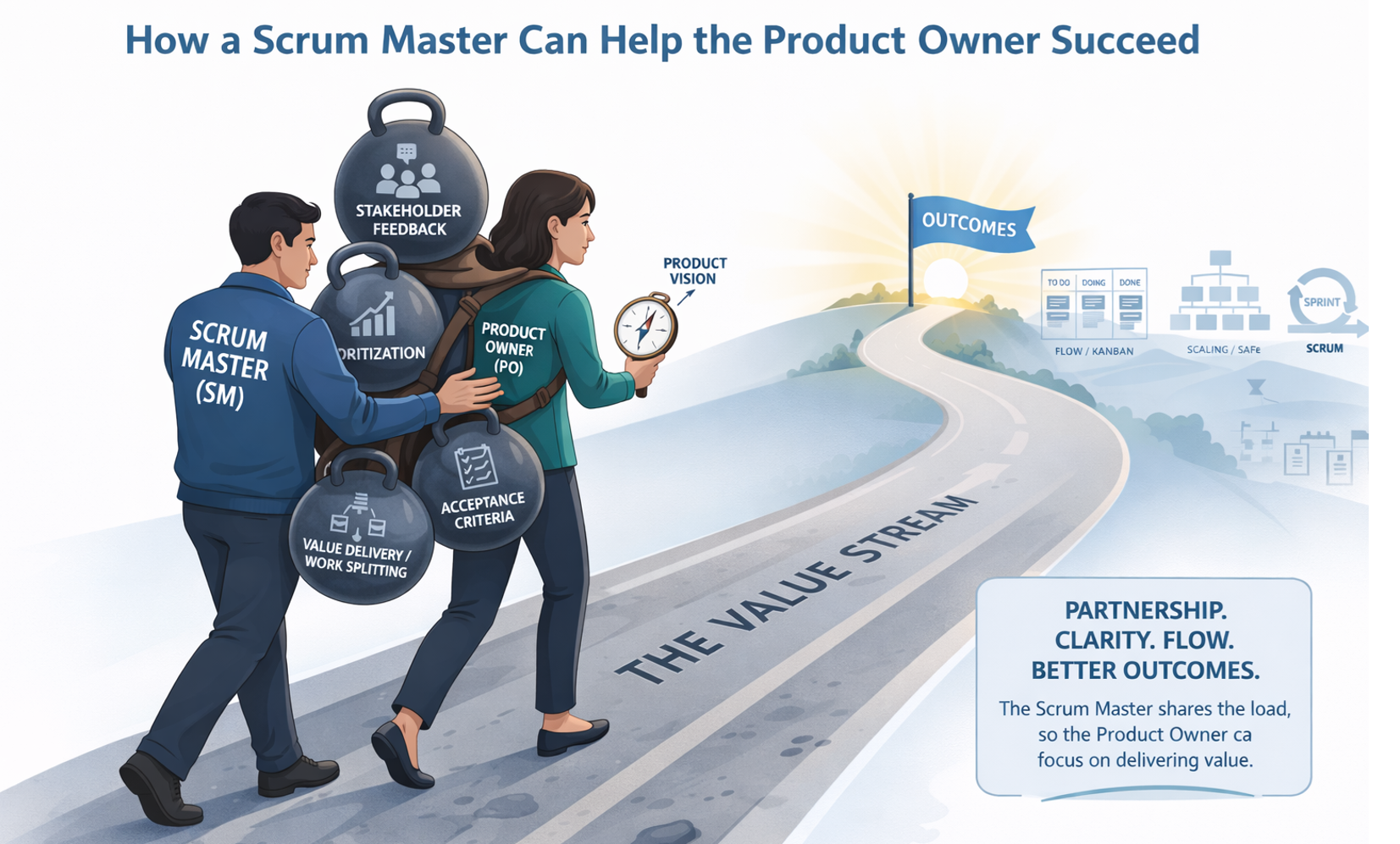
Introduction: Why does the Product Owner Need Support from The Product Owner?
The role of a Product Owner is far more demanding than it appears on paper. Scrum Guide says the Product Owner has to maximize value. As such this person sits at the intersection of market forces, stakeholders, and technology. In order to balance the three, they need to constantly make decisions that balance benefits, risk, and delivery. As a Product Owner you will end up doing some
- Constantly balancing competing stakeholder expectations
- Managing and refining an ever-evolving Product Backlog
- Making high-impact prioritization decisions with incomplete information
- Bridging the gap between product vision and team execution
- Handling pressure to deliver value quickly while ensuring alignment
In fast-paced and complex environments, this responsibility can quickly become overwhelming. This pressure often pushes Product Owners into working in a reactive mode rather than enabling strategic, outcome-driven thinking. This is where the Scrum Master becomes a critical partner. Beyond facilitating events, an effective Scrum Master enables the Product Owner through coaching, structure, and flow—helping them move from reactive execution to intentional value delivery. Below, I have articulated some key areas where the Scrum Master supports the Product Owner
What Can the Scrum Master Do To Help the Product Owner
Teaching Scrum for Better Product Ownership
One of the most important ways a Scrum Master supports a Product Owner is through teaching Scrum. Product Owners usually operate in complex environments where misunderstandings about roles and expectations are common. Scrum Master teaches Scrum to Product Owners, stakeholders and Developers
- Teaching Scrum to Product Owners – Product Owners often are used to working in traditional ways of working. Helping them understand and implement self-management helps Developers to deliver value more effectively. Of Course, this, in turn, helps the Product Owner- our value custodian
- Teaching Scrum to Developers – Similar to the Product Owners, Developers also need teaching and hand-holding to work in Scrum. This obviously helps them deliver value more effectively.
- Teaching Scrum to Stakeholders – Organizations usually are diligent about teaching to Developers and Product Owners. But we often ignore teaching Scrum to stakeholders. But Scrum represents a very different way of working for the stakeholders. Like the Product Owners, the stakeholders are often used to working independently in the traditional way of working. They are not used to working hand in glove with Developers and the Product Owner. We see this often when the stakeholders resist requests for frequent refinement sessions and regularly scheduled Sprint Reviews.
Thus, The Scrum Master helps the Product Owner—and the broader ecosystem of Developers and stakeholders—understand how Scrum works in practice. This includes reinforcing accountabilities, clarifying boundaries, and fostering a shared understanding of value delivery. When the Scrum Master helps to build this alignment, it helps the Product Owner to focus on Value delivery.
Facilitating Effective Product Backlog Refinement
Product Backlog refinement helps ideas evolve into actionable work. But, without proper facilitation, it easily becomes inefficient or unfocused. The Scrum Master helps to keep refinement sessions structured, time-boxed, and collaborative. They help the team focus on clarity, alignment, and readiness. This helps to ensure the backlog items are well understood and appropriately sized When Scrum helps with effective Product Backlog Refinement, the Product Owner can concentrate on defining what needs to be built Here are some tips to help with effective Product Backlog Management
Strengthen the Product Backlog Management
Effective backlog management is more than maintaining a list of user stories. It is about continuously aligning work with value. Scrum Masters support Product Owners by introducing techniques such as story slicing, outcome-oriented thinking, and maintaining appropriate levels of detail. They help ensure that near-term work is clear while avoiding over-investment in distant priorities. The result is a backlog that remains dynamic, relevant, and value-driven.
Support Prioritization and Decision-Making
Prioritization is one of the most challenging aspects of the Product Owner role. Every decision involves trade-offs and invites in depth often conflicting discussions. The Scrum Master does not make decisions, instead they enhance decision quality. They introduce techniques like impact mapping, cost of delay, or WSJF. These techniques provide structured ways to evaluate priorities. This helps the Product Owner shift from reactive prioritization to more intentional and informed decision-making.
Enhance Stakeholder Collaboration
Stakeholders are essential to product success—but unmanaged interactions sometimes overwhelm the Product Owner. The Scrum Master helps design effective engagement models, ensuring that feedback is timely, relevant, and constructive. They facilitate meaningful Sprint Reviews and coach stakeholders on how to collaborate with the team. By creating structured communication channels, the Scrum Master enables better alignment without constant disruption.
Help the Product Owner to Align Product Vision with Outcomes
A common challenge for Product Owners is how to maintain an alignment between long-term vision and day-to-day backlog work. Scrum Masters help bridge this gap by encouraging outcome-driven thinking. They facilitate alignment with business goals, OKRs, or value streams, ensuring that backlog items contribute to meaningful outcomes. This strengthens the Product Owner’s ability to communicate direction and purpose.
Improving Flow and Delivery Predictability
Incorporating flow-based practices can significantly improve delivery outcomes. Scrum Masters help by introducing Kanban practices such as visualizing work, limiting work in progress, and tracking flow metrics like cycle time. These practices provide valuable insights into delivery patterns. For the Product Owner, this means better forecasting, clearer expectations, and more predictable delivery.
Removing Organizational Impediments
Product Owners face many challenges that go beyond the team level. Scrum Masters work to identify and remove these systemic impediments. Some examples are multi-team dependencies, governance delays, or organizational silos. Scrum Masters work within the organisational constraints and create an environment where the Product Owner can operate more effectively.
Fostering Strong Collaboration with the Team
Product success depends on collaboration between the Product Owner and Developers. Scrum Masters coach both sides to move away from a “handoff” mindset toward shared ownership. They encourage continuous dialogue, joint problem-solving, and active participation. This leads to stronger alignment and better outcomes.
Conclusion: Scrum Masters Help the Product Owner Succeed by enabling Product Success Through Partnership
Ultimately, the effectiveness of a Product Owner is deeply influenced by the support system around them—and the Scrum Master is central to that system. Scrum Masters go beyond facilitating Scrum events. A skilled Scrum Master elevates the Product Owner’s ability to think strategically, act decisively. They help the Product Owner collaborate effectively with Developers as well as Stakeholders. A Scrum Master combines coaching, facilitation, and flow-based practices to help shift Product Owners from reactive execution to value-driven delivery. This partnership can be a true force multiplier. When the Scrum Master and the Product Owners work in tandem, they go beyond delivering increments. Together, they enable outcomes, accelerate learning, and drive meaningful business impact.