Real-Life Scenarios when multiple Teams are working on the Same Product
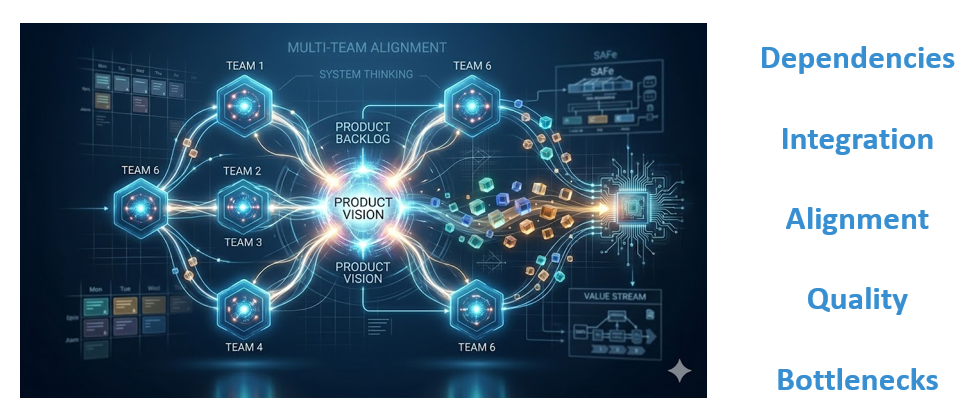
In this section, we will look at some real-life scenarios that Scrum Team(s) often face when multiple Teams are working on the Same Product . This article is part of an ongoing series on real-life scenarios that many Scrum Teams face. Adding more teams to a product should increase speed. That’s the expectation. However, in many organisations, the opposite happens. Despite having multiple Scrum Teams working in parallel, delivery slows down, dependencies increase, and alignment becomes harder. Teams stay busy, but product progress feels inconsistent. The problem is not the number of teams—it is the complexity that comes with them. Working with multiple teams on the same product requires a different level of discipline, collaboration, and clarity. Without it, scaling Agile can quickly turn into scaling confusion. Based on my experience working with multi-team environments across Scrum, SAFe, and Kanban setups, here are some real-life scenarios that frequently emerge.
1. “We are done” (But Others cannot use it!!)
Team A completes their work and marks their stories as “Done.” However, when Team B tries to use the same functionality, they run into issues—missing APIs, incomplete validations, and inconsistent behaviour. From Team A’s perspective, the work is complete. From Team B’s perspective, it is not usable.
Snehamayee’s perspective
What’s happening here? Each team delivers their work with their own interpretation of what “Done” means. There is a clear lack of a shared understanding at the product level. Impact: Work appears complete on dashboards, but real progress is not seen. Instead, the teams struggle with rework, delays, and frustration What we can do?
- A shared Definition of Done across teams is critical. It should include integration, usability by other teams, and alignment with product-level quality standards. “Done” should mean usable—not just complete within a team boundary.
- Integrated Solution level or Product level reviews – SAFe (Scaled Agile Framework ) recommends regular System demos. These are integrated demos – These will enable teams to “see” how their work is being used by other teams. These demos also help the teams as they encourage collaboration
2. Dependency Chaos Between Teams
A very common situation in multi-team setups is when one team’s progress depends heavily on another. You often hear statements like: “We can’t start until Team B finishes their part.” Or “We’re blocked waiting for the API from Team C.” Snehamayee’s perspective What’s happening here? Some possible reasons are
- Component Teams -Teams are often structured around components rather than features. This leads to tight coupling between teams.
- Inefficient work slicing – In addition, the work slicing (splitting work across teams) often creates additional dependencies across team boundaries
Impact: Planning becomes uncertain, commitments become unreliable, and teams lose their ability to deliver independently. Instead of enabling speed, multiple teams create bottlenecks. What we can do?
- Reducing dependencies should be a continuous focus. This may involve rethinking backlog slicing, re-assignment of work, or even restructuring teams toward more feature-oriented ownership.
- Dependency Board – Visually tracking the multi-team dependencies will help the teams identify critical path to monitor, bottlenecks to be aware about and trigger remedial actions in advance to reduce dependencies. Another SAFe technique the ART planning board will help.
- Design Feature Teams –Teams that are designed to deliver end to end value rather than a specific component help with easier coupling
3. Conflicting Priorities Across Teams
In another setup, each team appears busy and productive. However, when viewed from a product perspective, progress is slow and scattered. Different teams work on different priorities—some on new features, others on technical improvements, and some addressing stakeholder requests.
Snehamayee’s perspective
What’s happening here?
There is no clear alignment at the product level. Teams optimize for their own backlog rather than a shared product goal.
Impact: High activity does not translate into meaningful outcomes. Work gets fragmented, and the product evolves in an inconsistent manner. What we can do?
- Clear product-level prioritization is essential. Whether through a single Product Owner, a Chief Product Owner, or a well-aligned Product Management function, teams need a shared understanding of what matters most.
- A cross-domain planning session – A common planning session across teams will help the teams to align their priorities and expectations.
4. Integration Becomes a Nightmare
Integration of work is one of the most common challenges for the multi-team product. Each team develops and tests its work independently. Everything works fine within team boundaries. However, when all components come together, issues start to surface—unexpected defects, incompatible interfaces, and performance problems.
Snehamayee’s perspective
What’s happening here?
Integration happens too late. Teams work in silos with limited visibility into how their work interacts with others.
Impact: Integration risks accumulate over time. On top, these integration risks will often surface at the worst possible moment—close to release timelines.
What we can do?
- Frequent integration is key. Practices such as continuous integration, shared environments, and automated testing help reduce surprises. Integration should not be treated as a separate phase—it should be part of everyday development.
- A common Sprint Duration – A common Sprint Duration will provide a cadence needed for frequent integration
- Regular Integrated demos Or System demos as defined by SAFe will help. These demos help to enforce regular integration
5. Ownership Confusion – “Who Owns This?”
In multi-team environments, features often span across teams. This creates situations where responsibility is unclear. When an issue arises, the response is often: “This part belongs to Team A.” or “That integration is handled by Team B.” or “This is not our responsibility”
Snehamayee’s perspective
What’s happening here?
Ownership is divided along component or functional lines, rather than end-to-end product outcomes.
Impact: Slow decision-making, blurred accountability and issues that take longer to resolve. In some cases, important items fall through the cracks because no team feels responsible.
What can we do? Clear ownership of outcomes is critical. Even if multiple teams contribute, there should be clarity on who is accountable for delivering the feature end-to-end. Shifting toward feature ownership rather than component ownership can help address this challenge.
Final Thoughts on Real-Life Scenarios Faced by Scrum Teams When Multiple Teams Work on the Same Product
Working with multiple teams on the same product is not just about adding capacity(or people). It is about managing complexity. Many of the challenges discussed above are not caused by a lack of skill or effort. They arise from gaps in alignment, communication, and shared understanding. Some common issues I have seen across many customers are:
- Lack of shared standards – for example, a common integrated Definition of Done or common quality standards
- High dependencies between teams means a tight coupling and more limitations
- Misaligned priorities lead to effort wastage and rework
- Limited focus on integration and ownership
It takes conscious effort to address these challenges. Some tips that help are
- Better Alignment among teams by planned multi team events like structured cross-domain planning
- Establishing collaboration forums like dependency boards
- Designing feature teams that deliver end to end value and move away from component teams
Organisations that recognise and actively address these patterns are more likely to realise the true benefits of scaling Agile. Those that do not often find themselves adding more teams—but not necessarily delivering more value.