Does Agile Need Project Managers? A Reality Check
Introduction: Agile and Project Managers
“Agile doesn’t need Project Managers.” Or “Project Managers are getting obsolete”
I often hear this statement. People often say this with conviction, sometimes with relief, and occasionally with confusion.
Over the last decade or so frameworks like Scrum and Kanban have become more famous. And that brought a shift away from traditional roles. Scrum, in particular, explicitly defines only three accountabilities: Product Owner, Scrum Master, and Developers. Scrum Guide does NOT mention a project manager at all.
And just like that, many organizations concluded: the Project Manager role is obsolete. We do not need Project Managers any longer…..
But is that the right conclusion ? — Or have we misunderstood what Agile is actually trying to change?
I do not plan to defend job titles in this article. Instead, I want to discuss and examine the ground reality. I want to talk about what actually happens in Agile projects beyond theory, certifications, and frameworks.
Where Did This Question Come From?
To understand the confusion, we need to go back to traditional project management.
In a traditional setup, the Project Manager was the central authority. This person was responsible to plan, track, report, manage the risk management, communicate with team and stakeholder and above all ensure value delivery.
With so much to do, project managers often became a bottle neck.
Agile challenged this model.
Instead of centralized control, Agile emphasized:
- Self-managed teams
- Collaboration over hierarchy
- Adaptability over rigid planning
In doing so, Agile (more specifically Scrum) didn’t explicitly include the Project Manager role.
Many interpreted this as “no need for project managers.”
That’s a dangerous assumption and a myth!
While Agile removed the role as a command-and-control authority, it did not eliminate the responsibilities that ensure delivery.
What Agile Frameworks Actually do Say about Project Management
Now Let’s separate the myth from reality.
We saw that Scrum did not specifically ask for Project Managers
What Does Scrum Say about Project Managers?
Scrum defines accountabilities clearly—and Project Manager isn’t one of them. But Scrum operates at the team level. It assumes a relatively contained environment where a single team can deliver value incrementally.
It does not address:
- Cross-team dependencies
- Complex stakeholder landscapes
- Organizational constraints
Kanban and the Project Manager
Kanban goes even further. It doesn’t mandate specific roles at all. Kanban focuses on evolutionary change, improving the flow via work visualisation, and limiting work in progress.
But again, it assumes a system where flow can be managed effectively. Someone still needs to ensure alignment, remove bottlenecks, and manage expectations. These days, roles emerge for flow management in kanban. Some common roles are the Service Delivery Manager (SDM)(who manages workflow and removes bottlenecks – similar to a Scrum Master), and the Service Request Manager (SRM) (who manages the backlog and prioritizes customer requests – like a Product Owner)
SAFe (Scaled Agile Framework) and the Project Manager
SAFe also does not have a designated role called a Project manager. However, SAFe does include roles like the Release Train Engineer, the Product Manager, and the System Architect.
Question is Why?
Because at scale, coordination and alignment is critical. Dependencies multiply. Stakeholders increase. Complexity grows.
And suddenly, the need for overarching thinking becomes undeniable.
The Reality of Agile Projects on the Ground
In real organizations, Agile projects today rarely operate in isolation. They involve:
- Multiple teams working on shared outcomes
- Dependencies across systems and functions
- Stakeholders with competing priorities
- Pressure to deliver faster, with quality
Now ask yourself:
- Who ensures that all of this comes together?
- Who aligns teams when priorities conflict?
- Who manages risks that span across teams?
- Who communicates with stakeholders beyond the team level?
- Who takes accountability for multi team integrated delivery outcomes?
Self-organizing teams are powerful—but they are not designed to solve organizational complexity on their own.
So Who Actually Does this Work?
Even in Agile environments, the following responsibilities don’t disappear:
- Stakeholder Management – Aligning expectations, managing communication
- Dependency Management – Coordinating across teams and systems
- Risk Management – Identifying and mitigating delivery risks
- Planning at Scale – Beyond sprint-level planning
- Delivery Accountability – Ensuring outcomes, not just outputs
What happens on ground? These responsibilities are often:
- Distributed
- Unclear
- Or silently pushed onto Scrum Masters, Product Owners, or senior team members
This creates confusion—and sometimes, burnout. Read this article to understand the Scrum Accountabilities and what happens when we ask people to wear multiple hats
The Emergence of the Agile Project Manager
In many organizations, something interesting happens. The role doesn’t disappear—it evolves. The title may not be “Project Manager” anymore. Instead, the new title can be:
- Delivery Manager
- Program Manager
- Agile Project Manager
- Release Train Engineer
But the essence remains the same:
Someone is responsible to connect the dots.
When you assume the title of an Agile e Project Manager, you do not assume a command-and-control authority.
Instead, you become a
- A Facilitator of alignment
- A Enabler of flow
- A Manager of complexity
and
- An Influencer without formal authority
When Agile Projects Fail Without Project Management
Let’s be honest—many Agile transformations struggle.
Not because Agile doesn’t work, but because critical responsibilities are ignored.
Common patterns include:
- Teams delivering increments that don’t align with business outcomes
- Dependencies causing delays and frustration
- Stakeholders feeling disconnected and dissatisfied
- Lack of clear ownership for delivery risks
In such cases, Agile doesn’t feel empowering—it feels chaotic.
And often, the missing piece is not process—it’s project-level thinking and coordination.
What Makes an Agile Project Manager Different
If Agile still needs project management, then what changes?
Everything.
The Agile Project Manager is not:
- A task assigner
- A status tracker
- A gatekeeper
Instead, they:
- Enable flow, not control work
- Facilitate decisions, not impose them
- Influence stakeholders, not manage them through authority
- Focus on outcomes, not just timelines
It’s a shift from control to alignment and orchestration.
Snehamayee’s Thoughts
So do you need an Agile Project Manager? The answer is: it depends.
You may not need a dedicated Project Manager when:
- You have a single, small, co-located team
- Dependencies are minimal
- Stakeholders are closely aligned
But as complexity increases—
- Multiple teams
- Distributed environments
- High uncertainty
- Organizational constraints
—project-level coordination becomes essential.
Call it what you want, but the capability must exist.
The Bigger Problem: We’re Asking the Wrong Question
“Do Agile projects need Project Managers?” is the wrong question.
The better question is:
Do Agile projects need strong project management capabilities?
The answer is clearly yes.
Organizations don’t fail because they have Project Managers.
They fail because they lack clarity on how the role should evolve in Agile.
Conclusion: A Project Manager for an Agile Project is still relevant – You just have to align the work for Agile Realities
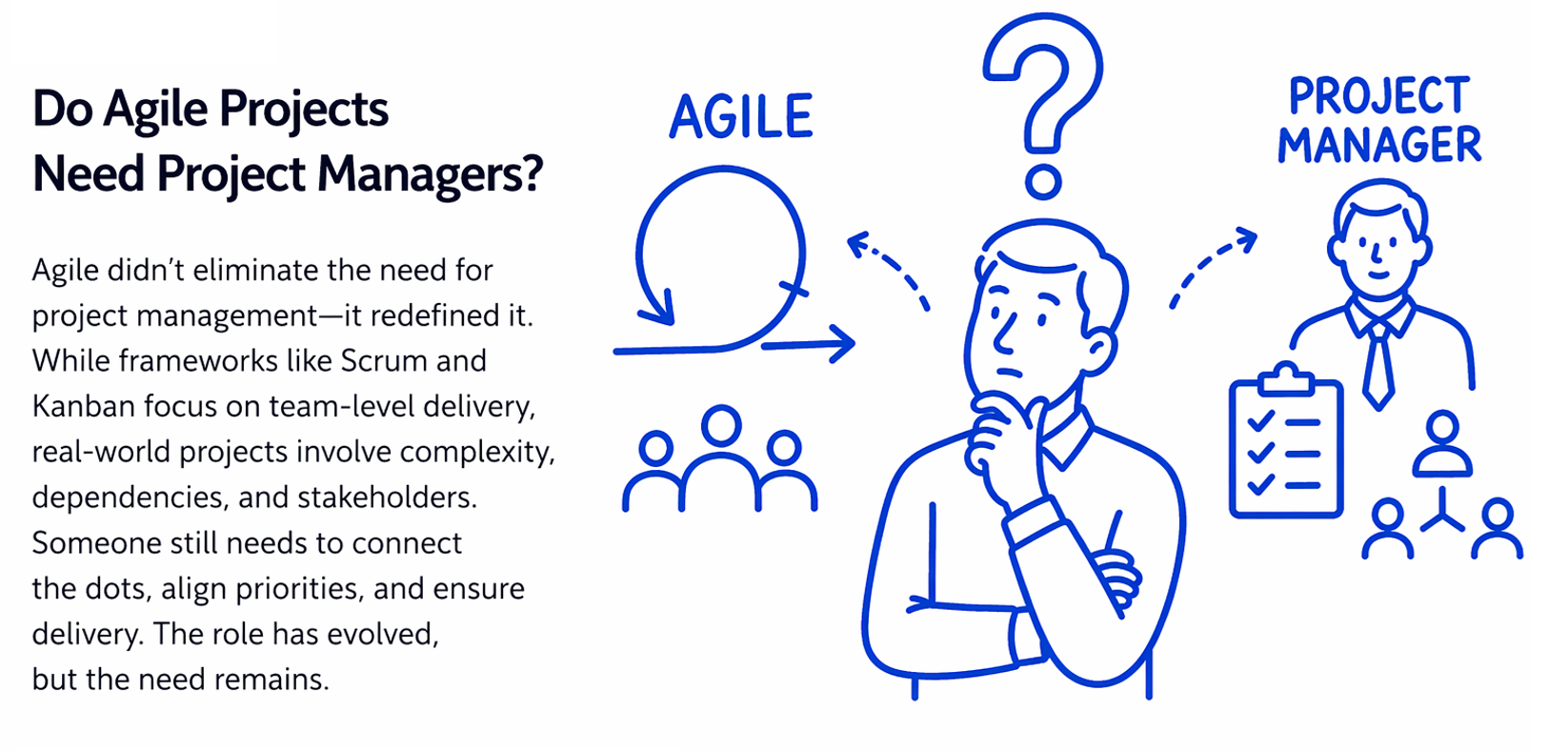
Agile didn’t eliminate the need for project management.
It redefined it.
The role is no longer about control—it’s about enabling alignment, managing complexity, and ensuring delivery in dynamic environments.
Whether you call it a Project Manager, Delivery Manager, or something else doesn’t matter.
What matters is this:
If no one is taking ownership of project-level responsibilities, your Agile setup is incomplete.
Reflection for you:
In your Agile projects today—who is actually handling project-level responsibilities?