Shared Roles in Scrum Teams: Real-Life Challenges and What Works
In this section, we will look focus on Shared Roles in Scrum Teams: Real-Life Challenges and What Works. We will explore how the value delivery gets impacted when one person takes on more than one Scrum Role within a Scrum Team. This article is part of an ongoing series on real-life scenarios that many Scrum Teams face.
“We are a small team, so one person needs to take up multiple roles. We do not have a budget for a dedicated Scrum Master (or a dedicated Product Owner)”
This is one of the most common statements I hear. Especially when organizations start their Agile journey. On the surface, it does sound practical. Why not optimise for efficiency? Why not reduce overhead? After all, if someone has the bandwidth, why not let them wear multiple hats?
However, in reality, role sharing in Scrum often creates more challenges than it solves. The issue is not a matter of capability—it is a conflict of accountability.
How do the three Roles (or Accountabilities as stated in the Scrum Guide) Interact
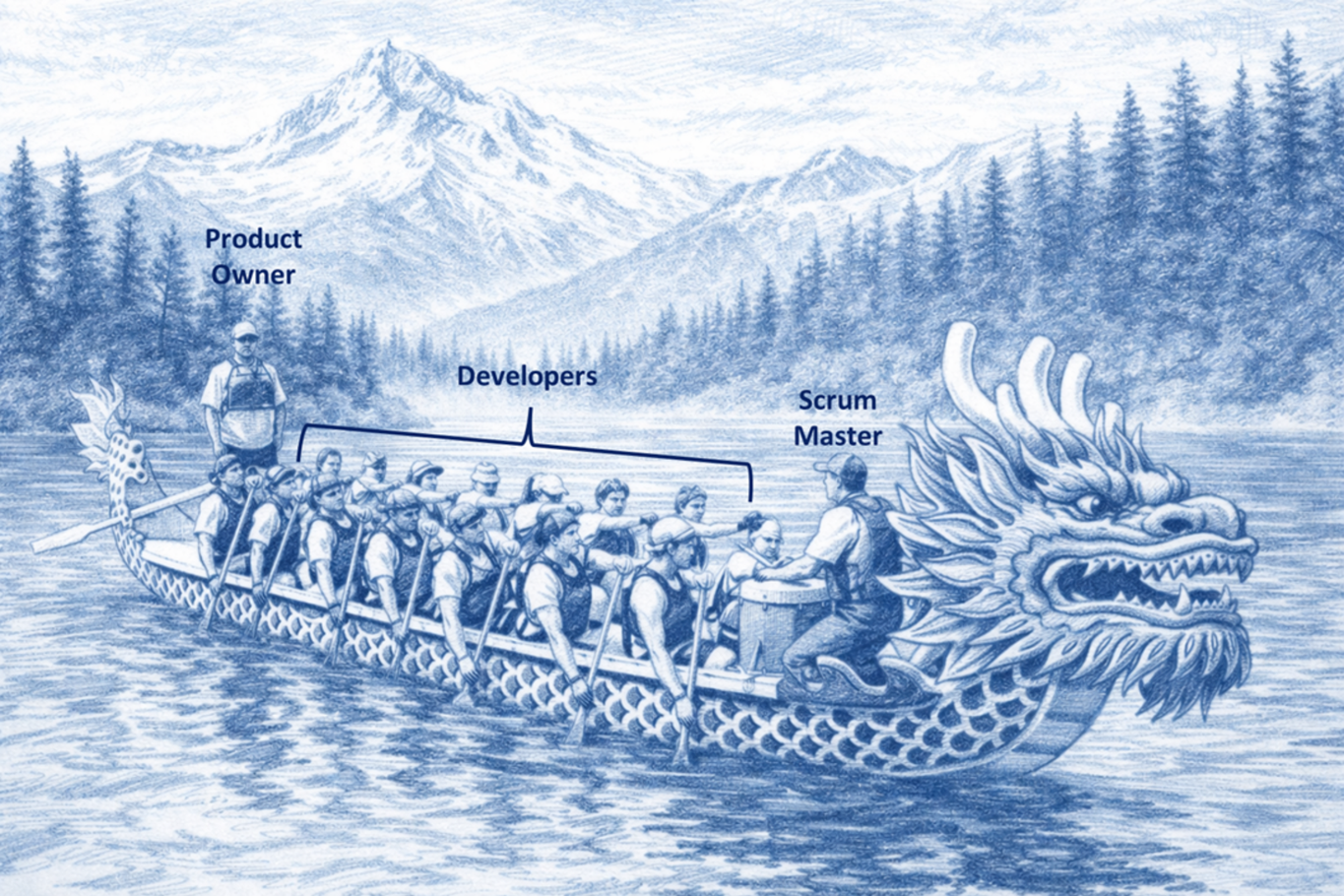
The people in the boat in the above diagram represent a Scrum Team. The rowers symbolize the developers. They work in sync to move the product forward through their collective effort.
The Product Owner stands at the back with the rudder, setting direction and ensuring the team is heading toward the right outcomes. His focus is always on the Value
At the front, the drummer, represents the Scrum Master. He is maintaining rhythm and helping the team stay aligned and effective. He is the facilitator who helps the Scrum Team become more effective
Success for the Scrum Team depends on coordination among the three roles. Success comes when direction, facilitation, and execution come together, the team moves faster and with greater purpose.
Below, I have described some common questions around role sharing—and what typically unfolds.
1. Can the Scrum Master and Product Owner Be the Same Person?
In one organization, I worked with a team where the same individual was acting as both Scrum Master and Product Owner. Initially, it seemed efficient—one person managing both delivery and process.
However, during Sprint Planning, this person consistently pushed the team to take on more work. In Retrospectives, when the team raised concerns about overload, the same person facilitated the discussion.
Over time, the team stopped speaking openly.
Snehamayee’s perspective
While the Scrum Guide does not explicitly forbid this, in practice, this combination rarely works well. The accountabilities of a Scrum Master and a Product Owner are fundamentally different. The Scrum Guide says that
- The Product Owner is accountable for maximizing product value
- The Scrum Master is accountable to help the Scrum Team become more effective
When the same person plays both roles, they need to balance conflicting priorities.
Impact:
- Reduced transparency
- Limited psychological safety – Product Owner is the Value Mximizer. In that role the often
- biased decision-making.
What can be done?
Keep these roles separate. Even in smaller setups, this separation creates balance and enables better team dynamics.
2. Can the Scrum Master Also Act as a Developer?
In another team, the Scrum Master was also a senior developer. During the Sprint, he was deeply involved in coding critical features.
When impediments arose, they often remained unresolved for days—not because they were complex, but because the Scrum Master was busy with delivery work.
Daily Scrums became quick updates rather than meaningful conversations.
Snehamayee’s perspective
This setup is more workable than combining Scrum Master and Product Owner roles, but it still creates tension.
The Scrum Master role requires availability and focus. When combined with development work, facilitation and coaching often take a back seat.
Impact:
- Delayed impediment resolution
- Reduced focus on team improvement
- Scrum events becoming less effective
What we can do?
This model can work temporarily, especially in smaller teams. However, it requires conscious effort to ensure that Scrum responsibilities are not neglected.
3. Can the Product Owner Also Act as a Developer?
I once worked with a technically strong Product Owner who also contributed to development. Initially, this helped speed up delivery.
However, over time, a pattern emerged. Backlog refinement became less structured, stakeholder conversations were delayed, and priorities were not always clear.
The Product Owner was simply too busy writing code to focus on product direction.
Snehamayee’s perspective
While this setup may seem efficient, it often impacts the quality of product ownership.
The Product Owner’s role requires continuous engagement with stakeholders, clarity on priorities, and proactive backlog management.
Impact:
- Backlog items lack clarity
- Stakeholder alignment weakens
- Product decisions get delayed
What can be done?
A Product Owner with technical skills can support the team when needed, but their primary focus should remain on product value and direction.
4. One Person Supporting Multiple Teams as a Scrum Master or a Product owner
In a scaled setup, I worked with a Product Owner who managed the backlog for three teams working on the same product. Initially, there were concerns about bandwidth.
However, over time, this setup created better alignment across teams. Priorities were clearer, and duplication of work reduced.
Similarly, a Scrum Master supporting two teams helped bring consistency in practices and improved cross-team collaboration.
Snehamayee’s perspective
This approach is often more effective than combining roles within a team.
When one Product Owner supports multiple teams, it strengthens product-level thinking. A Scrum Master across teams can identify systemic issues and address them more effectively.
Impact:
- Improved alignment across teams
- Consistent prioritization
- Better coordination
Some Points to keep in mind
- Beware of a too busy Scrum Master (or Product Owner). If we ask one person to be the Scrum Master (or the Product Owner) for too many teams, they become mere coordinators. It limits the value they add and the bandwidth they have for team members.
- Position an Experienced Person with proven credentials, Scrum Master and Product Owner, both are senior leadership roles – People take time to grow in these roles. If we ask someone inexperienced to function as a Scrum Master (Or a Product Owner) of multiple teams, we risk the role getting diluted
- Empower and Cross Train The Developers
Final Thoughts about Shared Roles Among Strum Teams
Role sharing in Scrum is often driven by practical constraints. While some combinations may work temporarily, others introduce deeper challenges that impact team effectiveness.
From my experience, a few principles stand out:
- Avoid combining Scrum Master and Product Owner roles
- Be cautious when mixing Scrum roles with delivery responsibilities
- Prefer sharing roles across teams rather than combining them within a team
Ultimately, it is not about rigidly following rules, but about ensuring that each accountability is fulfilled effectively.
When roles are clear, teams collaborate better, decisions are more balanced, and delivery becomes more predictable.